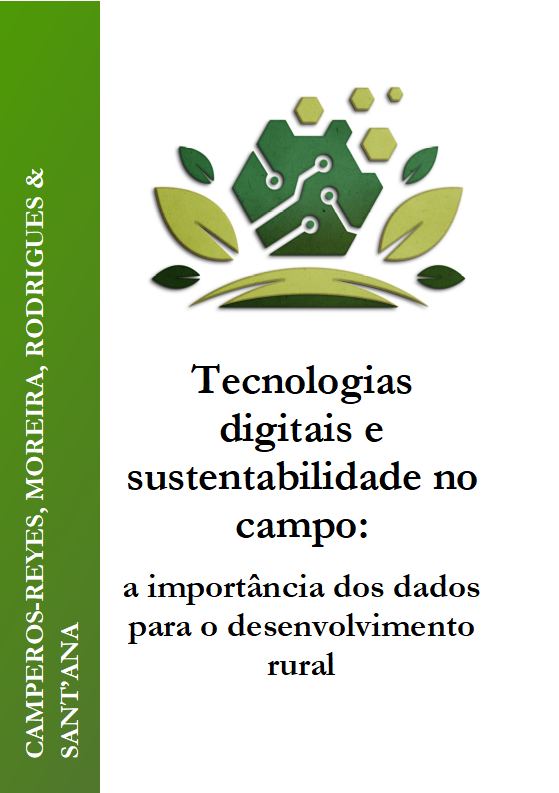
The ebook titled "Digital technologies and sustainability in the countryside: the importance of data for rural development", with ISBN registration: 978-65-88374-01-6, brings together the papers presented at the VII International Digital Skills for Family Farming Meeting (VII e-CoDAF), held online in November 2020.
Three strands set the common thread of the papers in this collection: (i) Automation of agricultural production processes; (i) Public information policies for the small producer; and (iii) Use of ICT in accessing agricultural information.
In the first strand, the following papers stand out: ‘Automation in agriculture: affordable technology for small rural producers’, by Alan Vinicius de Sousa and Rodrigo Vilela da Rocha, which presents a prototype built with microcontrollers to increase productivity and quality in the field through autonomous irrigation and soil nutrition; and ‘The use of technology to control water levels in fish farming for sustainable production’, by Edgar Hissakazu Hazaski and Rodrigo Vilela da Rocha, who sought to provide rational use of water resources using tools such as Arduino; and ‘Use of drones in the operational logistics of beef cattle management: applicability of the technology on a rural property’, by Pedro Vitor Uliam Dalaqua, Ícaro Alex’Sanderson Pereira de Godoy and Luciana Boulhosa Fabris, who explored the possibilities of precision livestock farming using an innovative resource to obtain data for decision-making in livestock activities.
The second strand is represented by the papers: ‘Incentives and the digital age: driving tools for sustaining family farming’, by Alessandra de Haro Ribeiro, Fernanda Camargo de Macena and Edson Roberto Manfré, which systematizes policy instruments that can boost the productive activity of small producers by providing access to technological resources; and ‘The importance of municipal programs for local development: actions and results of the Conecta Aratiba project’, by Gessica Fantin and Zenicleia Angelita Deggerone, reporting a case study of a public-private partnership that aimed to contribute to digital inclusion in the state of Rio Grande do Sul (Brazil).
Finally, the last theoretical strand of this collection is represented by the paper titled ‘Synchronous Virtual Reference Service in the digital information environments of the EMBRAPA library system’, by Nashila Fernanda Soares and Jaquelin Teresa Camperos-Reyes, who analyzed all possible forms of communication between the library system of Brazil’s main agricultural research institution and the information subjects who request its services.
Through this scientific communication initiative, the CoDAF Project reinforces the importance of the academic community and other interested parties continuing to observe the problems of the rural production sector made up of small and medium-sized producers, confident that data and information access technologies can strategically contribute to the development of the social and economic dimensions of these actors.
Read the full ebook at: https://dadosabertos.info/events/ecodaf/viiecodaf_proceedings.php
The accuracy of the information on this page, as well as of the images and photographs, is the sole responsibility of the cited sources and does not necessarily reflect the opinion or position of the Digital Skills for Family Farming (CoDAF) outreach project, its collaborators or the institutions linked to the project.